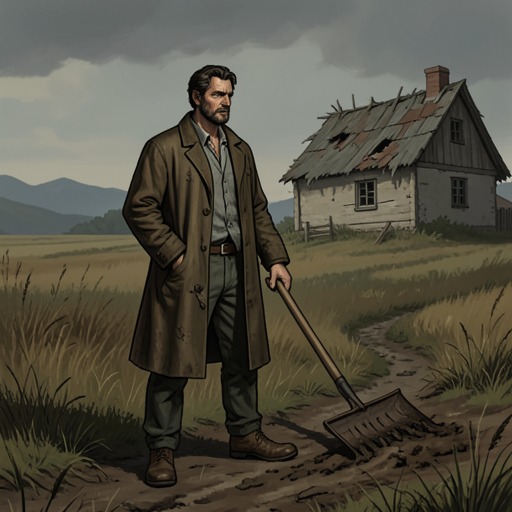
Qiqikofu purchased the Herlobyev estate
Dead SoulsChichikov’s purchase of Khlobuev’s estate marks a change in the scale and substance of his ambitions: he becomes, for the first time, not merely a fictitious proprietor but the owner of an existing estate. The transaction exposes the estate’s ruin, the seller’s urgent need for money, and Chichikov’s reluctance to part with it; afterward, the prospect of actual management briefly redirects him toward patience and labor.
The journey to a neglected estate
The day after discussing his plans, Chichikov sets out with Platon and Kostanzhoglo to meet Khlobuev, whose estate Kostanzhoglo has agreed to help him buy through a ten-thousand-rouble loan without interest or formal security. Chichikov is in high spirits. The route itself makes the contrast between the prospective property and its neighbors visible: for roughly fifteen versts, the party travels through forest and cultivated land belonging to Platon and his brother-in-law; beyond their boundary, forest gives way to swamp and tillage to waste. Khlobuev’s village has a deserted air, foreshadowing the disorder and impoverishment they find at the estate.
Khlobuev is discovered still drowsy and disheveled, with a crooked cravat, a large stain on his coat, and a hole in one boot. Despite his circumstances, he welcomes his callers warmly and remarks that people usually avoid him because they expect him to ask for a loan. Kostanzhoglo introduces Chichikov as a possible buyer, making the visit’s business explicit: the estate’s failing owner and the newly arrived purchaser are to negotiate over the property.
Assessing the property and its liabilities
The inspection reveals a striking mismatch between poverty and fashionable display inside Khlobuev’s household. A volume of Shakespeare lies on a writing table, an ivory back-scratcher on another table; the hostess is dressed elegantly and talks about the town and its theatre, while the children are well dressed. Chichikov judges this profusion against the estate’s bad condition and the family’s evident want, imagining that the children would be better off in plain smocks, running in the courtyard like peasant children. The contrast gives the sale a human and social context: appearances of comfort persist amid material distress.
When Chichikov asks Khlobuev to name his lowest price, he argues that the property is in much worse condition than expected. Khlobuev agrees that it is in a terrible state and supplies a concrete measure of the estate’s losses. Of the hundred serfs recorded in the last revision, only fifty remain alive after cholera; some of those who survive have absconded and, in Khlobuev’s reckoning, must also be counted as lost, since pursuing them in court could consume the property in legal costs. He asks thirty-five thousand roubles for the estate, a price framed against both its diminished population and its precarious legal and financial position.
Bargaining over price and payment
Chichikov responds by offering twenty-five thousand. Platon objects that the estate is worth at least the asking price and says that he and his brother-in-law would buy it together if Chichikov would not. His intervention changes the negotiation: Chichikov, taken aback, accepts Khlobuev’s price rather than risk losing the property. Yet agreement on the total does not end the haggling. Chichikov asks to defer half the payment for a year, while Khlobuev refuses and explains that he needs the money to redeem the mortgage. He requests at least fifteen thousand immediately.
Chichikov claims that he has only ten thousand roubles available, although the narration clarifies that he actually has twenty thousand when the money borrowed from Kostanzhoglo is included. His hesitation is not simply a shortage of funds: he dislikes paying a large sum all at once. Platon offers to lend him the additional five thousand required for the immediate payment. Chichikov reacts with surprise at the prospect of a loan from Platon too, but the advance makes it possible to conclude the purchase.
The cash is brought from Chichikov’s carriage in his dispatch-box. Khlobuev receives ten thousand roubles, and Chichikov promises the remaining five thousand on the following day. Even then, Chichikov tries to postpone part of what he owes: he first proposes bringing only three thousand the next day and leaving the balance for two or three more days, or longer. The narrator identifies this delay as characteristic of his reluctance to part with money, even when another person’s need is pressing. The sale thus joins a real transfer of property to a revealing contest over time, cash, and the seller’s urgent claim.
From fictitious ownership to responsibility
After the visitors leave, Platon says that he feels sorry for Khlobuev. Chichikov answers that the man is a hopeless prodigal and that he cannot pity people of that sort. The two men’s responses differ: Platon feels sympathy, but the feeling does not remain with him; within minutes he has stopped thinking about his former host. Chichikov also turns away from Khlobuev, but his thoughts are occupied by what he has bought.
The purchase changes Chichikov’s sense of his own position. He is no longer only a fictitious proprietor: the estate actually exists, and it is now his. That fact makes him contemplative and lends his expression an unwitting air of importance. He tells himself that patience and hard work will be necessary, adding that he has known those qualities since childhood but wondering whether, in middle age, he can still attain the patience he once possessed. The ending does not show him improving the estate or completing its payment; instead, it leaves the purchase poised between acquisition and the labor it would require. Chichikov’s first real property makes ownership concrete, but it also raises the question of whether his habits of calculation and delay can become sustained work.